


Yellow sticky traps are one of the most commonly used tools for monitoring agricultural and forestry pests. Their principle is based on the attraction of most insects to specific wavelengths of yellow light. In greenhouses and fields, winged adults such as whiteflies, aphids, thrips, and leaf miners can be effectively trapped, providing a basis for population dynamics assessment and control decisions. Based on years of field monitoring experience and relevant domestic and international research, the author has systematically compiled the following operating procedures.
I. Preparation Before Monitoring
Regarding equipment, it is recommended to use double-sided coated yellow sticky traps of 10cm × 25cm, 30*30cm, or 20*40cm. The trap surface should have a grid to aid in rapid counting. Also prepare wooden stakes, binding straps, markers, and data recording sheets. A stereomicroscope (or at least a 20x handheld magnifying glass), tweezers, and a classification guide are needed for subsequent species identification.
II. Hanging Method
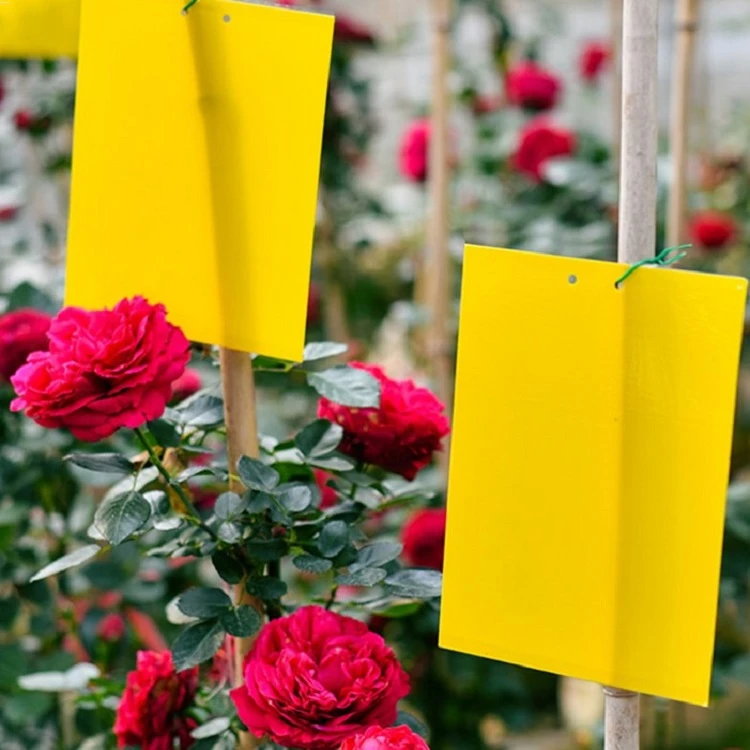
The hanging height is closely related to the crop type and the target pest. For low-growing leafy vegetables, yellow sticky traps should be hung 5-10 cm above the plant canopy and adjusted as the crop grows. Studies show that in tomato and cucumber greenhouses, the trap surface is most effective at attracting whiteflies when it is 0-20 cm above the top of the crop. When monitoring root leaf beetles in cornfields, yellow sticky traps should be attached directly to developing female ears; in orchards, the top of the yellow sticky trap should be parallel to the bottom of the tree canopy, and the south-facing trap is more effective than other orientations. Studies have shown that east-west oriented yellow sticky traps attract significantly more insects than north-south oriented ones, possibly related to the direction of sunlight.
III. Layout and Density
The layout of monitoring points should balance representativeness and spatial independence. In cherry tomato greenhouses, 64 permanent sampling points are set up in an 8×8 grid, and an area of 0.10-0.15 hectares is sufficient for accuracy requirements. When the crop distribution is relatively uniform, it is recommended to place one yellow sticky trap per 1000 square feet (approximately 93 square meters). In the field, six traps are placed along two transects spaced at least 330 feet apart in each 10-50 acre plot. The first trap is at least 165 feet from the field edge. Spatial autocorrelation analysis indicates that the yellow sticky trap spacing should be greater than 12.5 meters to ensure independent sampling.
IV. Replacement Frequency and Counting
The yellow sticky traps are replaced weekly. Counting can be done using either full-trap counting or strip sampling. Statistical analysis of 586 yellow sticky traps shows that the number of insects on a 1-inch wide vertical strip accurately reflects the overall trap density, and the counting time can be reduced by 80%. Species identification is crucial for ensuring monitoring reliability. Multiple whiteflies, thrips, or aphids may be mixed in the same trap, requiring differentiation based on morphological characteristics using a stereomicroscope.
V. Data Expression and Population Trend Assessment
Data should be expressed as "the number of adult insects captured per yellow sticky trap every 7 days." For example, if 12 traps capture 123 adults within 7 days, this equates to 1.46 adults/trap/day. Plotting weekly data as a line graph can visually reflect population fluctuations. The recommended activity threshold for thrips in greenhouses is 15 individuals per 1000 square feet per week. It is important to note that yellow sticky trap counts do not always accurately reflect the actual population density in the field, especially with seasonal aphids; the number of winged aphids migrating in can lead to misjudgments. Therefore, monitoring must be combined with regular field plant inspections.
VI. Precautions
When more than 60% of the sticky trap area is covered with insects or dust, it should be replaced as soon as possible. Yellow sticky traps also attract natural enemies such as ladybugs and parasitic wasps, which is an inherent limitation of this method and should be considered when designing monitoring programs.


